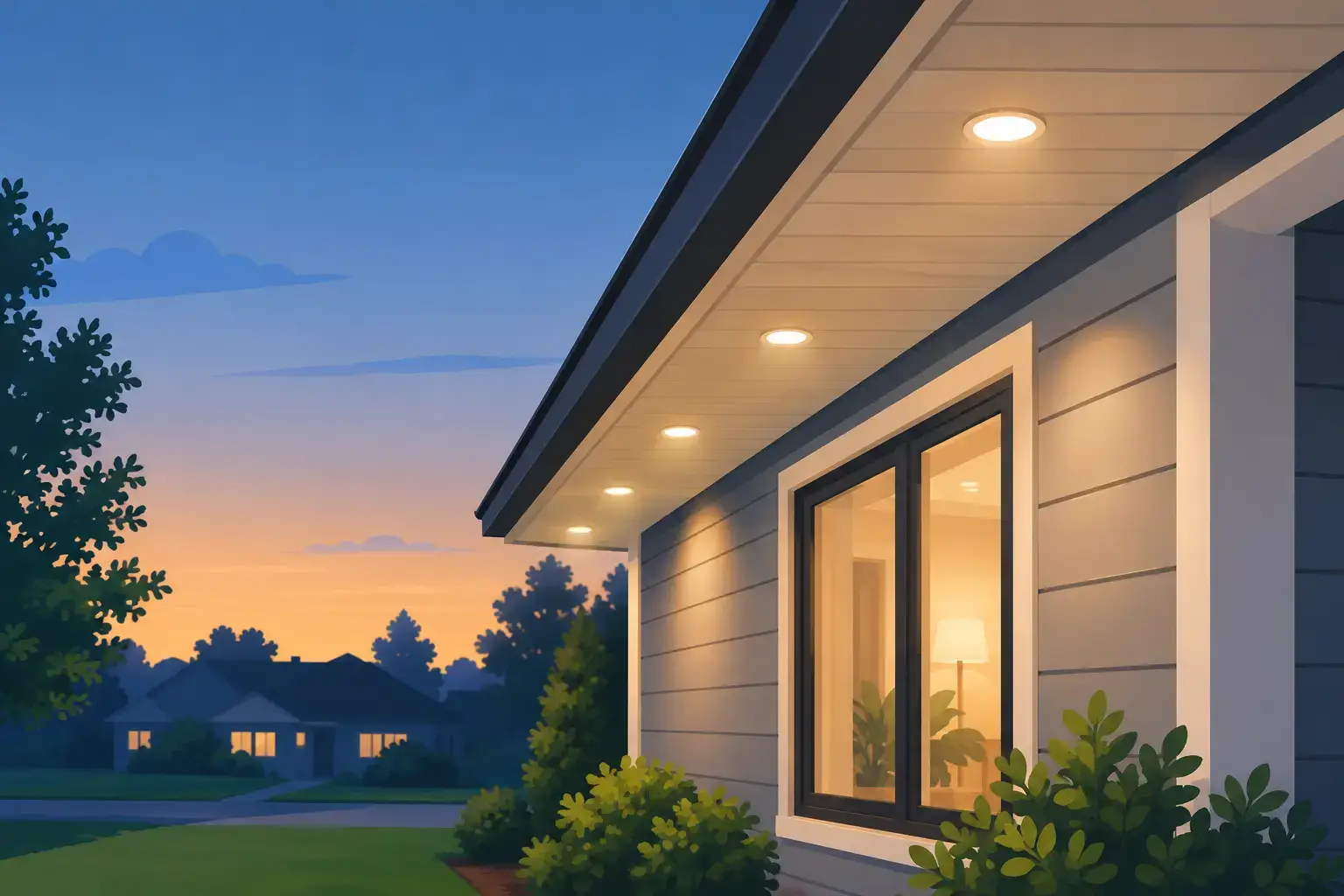
Soffit Lighting Installation for Safer, Smarter Homes
A dark driveway, side path or back door is more than an inconvenience on a wet Scottish evening. A well-planned soffit lighting installation gives you useful light exactly where you need it, without filling the garden with harsh floodlights or leaving visible fittings on the walls.
For homes across Fife and central Scotland, soffit lights are a tidy way to improve security, make arrivals safer and give the outside of the property a smarter finish. The best result is not simply a row of the brightest lights available. It comes from getting the position, spacing, switching and electrical supply right before anything is drilled.
What is soffit lighting?
The soffit is the underside of your roof edge - the board that runs beneath the fascia and guttering. Recessed lights can be fitted into this area to cast light down the walls, over doors, along paths and around the perimeter of a house.
Because the fittings sit under the eaves, they are less obvious in daylight than wall-mounted lights. They can also be better protected from the worst of the weather. That does not mean every fitting is suitable, though. Outdoor-rated equipment, sound cable routing and a proper assessment of the exposure at each part of the property are still essential.
Soffit lighting suits detached and semi-detached homes particularly well, but it can work on bungalows, extensions, garages and porches too. It depends on the depth and condition of the soffit, access above it and whether there is a sensible route for cables back to the electrical supply.
Why homeowners choose soffit lighting installation
Most customers want one or more of three things: safer access, a bit more security or better kerb appeal. Often, they get all three.
At the front of the house, discreet downlights can make the route from car to door easier to see. At the side or rear, they can remove the dark corners around bins, gates, garages and patio doors. For landlords, good exterior lighting can make a rental property feel safer and more looked after without creating a nuisance for neighbours.
There is also a practical advantage over a single powerful floodlight. Several lower-output lights can give a more even spread of light, reducing deep shadows and glare. A floodlight may still be the right answer for a large garden or wide driveway, but it is rarely the neatest choice for lighting an entire property frontage.
Planning a soffit lighting installation properly
A good installation starts by looking at the property after dark in your head, not by choosing fittings from a catalogue. Where do you park? Which door is used most? Is there a step, narrow path or gate that becomes awkward in winter? Do you want lights to come on automatically, or only when needed?
Position and spacing matter more than quantity
Lights set too far apart leave pools of brightness with black gaps between them. Set too close together, they can look cluttered and create a striped effect down the wall. The right spacing depends on the height of the eaves, the beam angle of the fitting, wall colour and what needs lighting below.
Doorways, corners and changes in level usually deserve priority. A front elevation may need only a small number of carefully positioned fittings, while a long side passage may benefit from more regular spacing. The aim is useful, comfortable light, not a runway effect.
It is also worth thinking about windows. Downlights placed directly above a bedroom window can create unwanted light indoors. Angles and positions can often be adjusted to keep the benefit outside without disturbing sleep.
Choose the right colour temperature
Colour temperature changes the feel of the finished job. Warm white lighting gives a softer, more welcoming look and often suits stone, brick and traditional homes. Cool white can appear sharper and brighter, which may suit a modern exterior or an area where visibility is the main priority.
Neither is automatically better. Mixing different colour temperatures across porch lights, soffit lights and existing wall fittings can look untidy, so it is sensible to consider the full exterior rather than each fitting on its own.
Decide how the lights will operate
A manual switch gives you full control and can be useful where the lights are mainly for occasional use. A photocell can switch them on at dusk and off at dawn. PIR motion sensors are a popular option around entrances and side paths, bringing the lights on only when movement is detected.
Each approach has trade-offs. Dusk-to-dawn lighting is convenient but uses power for longer. Motion sensors reduce running time, but they need sensible adjustment so they are not triggered constantly by passing cars, pets or wind-blown branches. Some homes use a combination, with selected lights on a sensor and others controlled separately.
The electrical work behind the finish
The clean finished look of soffit lighting can hide the fact that there is proper electrical work behind it. Cables need to be protected and routed safely, connections need to remain suitable for an outdoor environment, and the supply needs checking before extra load is added.
Where possible, cables may be routed through the loft space or roof void before reaching the soffit. In other homes, access can be more limited, particularly around extensions, flat roofs or converted lofts. The condition of the existing soffit boards also matters. Old, cracked or water-damaged boards may need attention before new fittings are installed.
A qualified electrician will assess the existing consumer unit, protective devices and circuit arrangement, then decide the safest practical way to supply the new lights. This is not a job for running an extension lead into the loft or joining cables above a ceiling without appropriate enclosures. Exterior electrics must stand up to damp, temperature changes and years of use.
LED fittings are normally the sensible choice. They use far less electricity than older lamps, give instant light and need less frequent replacement. However, built-in LED units vary in quality. Choosing suitable fittings from the start matters, especially when access for future replacement involves ladders or roofline work.
What can affect the cost and timescale?
There is no honest one-price answer for every house. A straightforward installation where there is easy loft access and a nearby suitable circuit is very different from a job requiring a new supply route, upgraded protection, difficult access or repairs to damaged roofline boards.
The number of lights, type of fitting, sensor controls and height of the property all affect the scope. A bungalow with accessible eaves may be relatively simple. A two-storey house with awkward access over a conservatory, garage roof or sloping ground will take more planning.
It is also worth deciding whether you want the work done in stages. Perhaps the front and side of the house are the immediate priority, with the rear garden added later. That can be a sensible route, provided the electrical design allows for it and the next steps are set out clearly.
Avoid the common mistakes
The biggest mistake is choosing lights purely by appearance. A fitting can look great online but be unsuitable for the location, too bright for the space or difficult to maintain once installed. Another is overlooking the neighbours. Exterior lights that shine across a boundary, into a window or towards the road can cause problems quickly.
Poorly placed sensors are another regular issue. If the sensor faces a busy pavement or driveway, the lights may switch on all night. If it faces the wrong way, you can reach the front door before it reacts. Settings should be checked in real conditions, not just assumed to be right on the day.
Finally, do not ignore the roofline itself. New lights will draw attention to tired soffits, damaged guttering or peeling exterior finishes. Sometimes a small repair or clean before the electrical work makes the final result look far better.
When to call a local sparky
If you are planning exterior improvements, get the lighting layout looked at before decorating, replacing soffits or carrying out landscaping. It is easier and cleaner to plan cable routes before other work is finished.
West Fife Sparky can assess soffit and exterior lighting for homes in Dunfermline, West Fife, Kirkcaldy, South Queensferry, Falkirk, Alloa, Kinross and surrounding areas. You will get a straightforward view of what is practical for your home, what needs done safely and whether any follow-on work is likely.
A few well-positioned lights can make the last trip to the bins, the walk in from the car and the turn of a key at the front door feel considerably safer. Plan them for the way you actually use your home, and they will earn their place every night.